Account Validation Sequences That Determine Access to Introductory Reel Rotations on Regulated Mobile Platforms
Written by Mara Lehmann · Sep 8, 2026

Account Validation Sequences That Determine Access to Introductory Reel Rotations on Regulated Mobile Platforms
Regulated mobile platforms require structured account validation sequences before users gain entry to introductory reel rotations, which function as initial bonus mechanisms in gaming applications. These sequences combine identity verification, age confirmation, geographic checks, and payment method authentication into a sequential workflow that platforms enforce to meet licensing conditions across multiple jurisdictions.
Developers integrate these steps into app onboarding flows so that each phase must complete successfully before the system unlocks the rotation feature. Data from platform operators shows that incomplete validation blocks access entirely, which prevents premature distribution of reel rotations and maintains compliance with regional rules.
Core Components of Validation Workflows
Validation begins with document submission, where users upload government-issued identification that automated systems cross-reference against databases maintained by third-party providers. Platforms then trigger location verification through device GPS and IP address analysis, a step that regulatory frameworks in North America and Europe mandate to restrict access by jurisdiction. Once location clears, age verification algorithms analyze submitted data against legal thresholds, and any mismatch halts the sequence.
Payment instrument linkage follows immediately after age approval, requiring users to connect a verified bank account or digital wallet that undergoes fraud screening. Observers note that this linkage often serves as the final gate before introductory reel rotations become available, because it confirms the account belongs to a real person rather than a synthetic identity.
Technical Implementation on Mobile Devices
Mobile applications employ API-driven sequences that communicate in real time with backend compliance engines. These engines log each validation event with timestamps and device identifiers, creating audit trails that regulators examine during routine inspections. Research indicates that platforms using biometric confirmation, such as facial recognition or fingerprint matching, reduce processing times while preserving the integrity of the sequence.
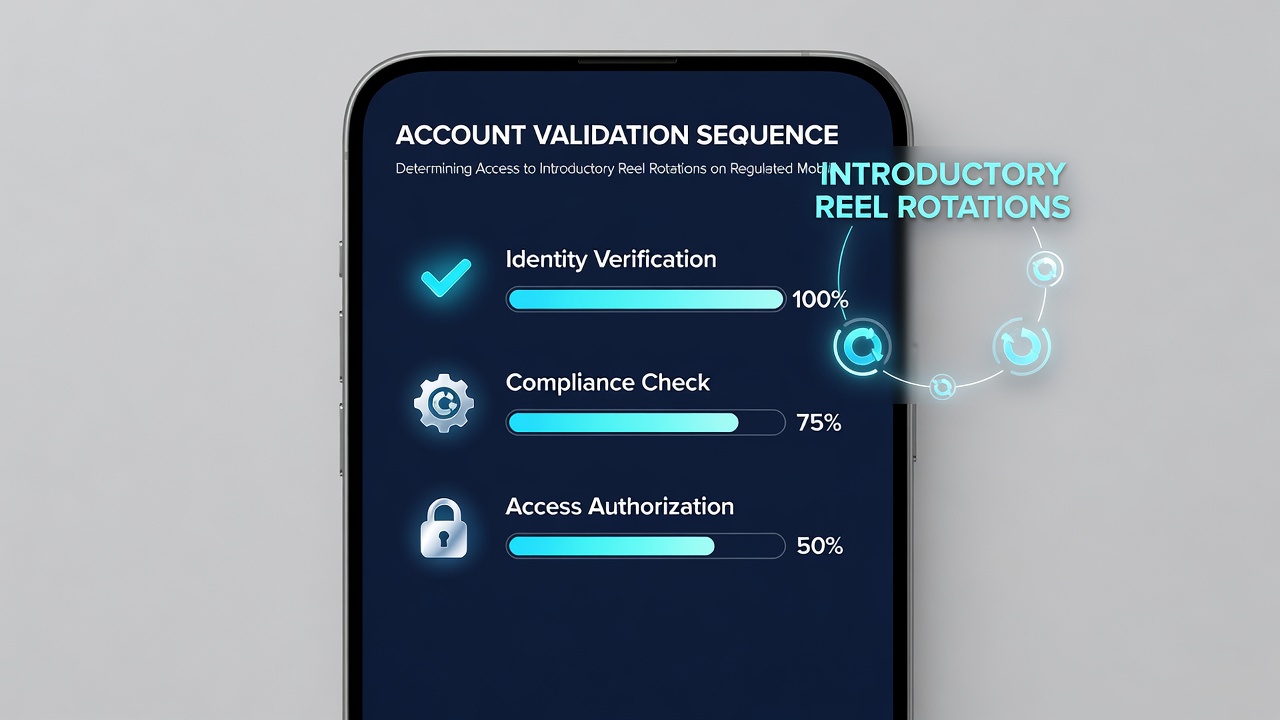
Engineers design these flows to accommodate interruptions, allowing users to resume at the last completed stage rather than restarting the entire process. Case studies from European operators reveal that such resumption features increase completion rates without compromising security protocols.
Regulatory Variations Across Regions
Jurisdictions impose distinct requirements that platforms must embed into their validation sequences. In Ontario, the Alcohol and Gaming Commission of Ontario requires explicit consent for data sharing during verification, which alters how mobile apps present disclosure screens before reel rotations activate. Australian state regulators, by contrast, emphasize responsible gambling checks that integrate directly into the age and identity steps.
According to the Alcohol and Gaming Commission of Ontario, updated technical standards scheduled for September 2026 will mandate additional device fingerprinting within validation sequences to further limit multi-account creation. Platforms operating across borders must therefore maintain separate compliance modules that activate based on detected user location.
Impact on User Access Timelines
Completion times for full validation sequences range from several minutes to several hours depending on document clarity and third-party response speeds. Platforms report that most delays occur during manual review stages when automated systems flag discrepancies. Once all stages pass, the system grants immediate access to introductory reel rotations, which users then activate through the main game lobby.
Those who study these systems have found that streamlined sequences correlate with higher retention in the first week after account creation, because users reach the rotation feature without extended friction. Yet the same studies show that overly complex flows increase abandonment rates before validation finishes.
Future Adjustments Scheduled for 2026
Industry reports project that several regulators will introduce enhanced data encryption standards by September 2026, which will require mobile platforms to update their validation APIs accordingly. These changes aim to protect user information exchanged during identity and payment checks without extending overall processing durations.
One study from an academic research group tracking gaming compliance revealed that platforms already testing these encryption upgrades experience minimal disruption to existing validation sequences while meeting forthcoming requirements.
Conclusion
Account validation sequences serve as the gatekeepers that determine whether introductory reel rotations become accessible on regulated mobile platforms. Each component, from document upload through payment confirmation, operates within a coordinated process shaped by regional licensing conditions. As technical standards evolve toward September 2026, platforms continue refining these workflows to balance compliance demands with efficient user progression through the sequence.